Why Radio Can't Compete for Young Professional Podcast Listeners
Young professionals are shifting listening time from radio to podcasts. Here's why strategic podcast distribution captures an audience radio cannot reach.
Something fundamental has shifted in how younger professionals consume audio content. According to recent industry data published by Podnews, 18 to 34 year olds now spend nearly as much time with podcasts as they do with traditional radio. For everyone else, radio still commands three times the listening hours. But that gap tells us exactly where the momentum sits, and it reveals an opportunity most business podcasters have yet to exploit properly.
The pattern is not about podcasts overtaking radio tomorrow. It is about a specific demographic making a permanent behavioural switch, and doing so for reasons radio cannot easily address. If your business podcast can position itself inside that shift with deliberate podcast distribution strategy, you gain access to decision-makers and buyers in a way broadcast radio never could.
Radio optimised for a commute that no longer exists
Radio built its dominance around the car journey and the fixed workday. Morning drive time, afternoon return, hourly news slots. The entire structure assumed people moved predictably through the same spaces at the same times, and that they had no alternative except silence or their own music collection.
That model still functions for older demographics. But young professionals, particularly those in knowledge work, operate differently now. Hybrid schedules mean the commute happens twice a week, not ten times. Work from home means listening happens at a desk, on a walk, during exercise, not during a fixed broadcast window. The podcast listener retention dynamic rewards shows that fit irregular schedules, not ones that demand you tune in at 8am or miss the discussion entirely.
Radio cannot solve this structurally. It can offer catch-up players and on-demand streams, but the content itself remains built for the linear broadcast. A podcast, by contrast, is built for the exact moment the listener chooses. That structural advantage matters more than production budget or presenter personality, because it aligns with how the audience actually lives.
The professional seeks signal, not background
Radio programming fills time. It must, because airtime is continuous and expensive. Podcasts fill attention, and only when the listener grants it. The difference is not subtle. A young professional choosing a podcast about leadership, marketing automation or sector regulation is making an active decision to learn something specific. They are not passively letting a station play while they drive. They are curating their own professional development, and they expect the content to justify the time.
This is where business podcasts win, provided they are made with that intent. A 25-minute episode analysing one strategic challenge in depth will outperform a two-hour radio magazine that touches the subject for four minutes between traffic updates and phone-in segments. The listener seeking signal will choose the former every time, and they will remember the brand that delivered it.
Radio chases reach. Podcasts chase relevance. For the 18 to 34 demographic, relevance has become the scarce resource, not access to content. They can listen to anything, so they listen to what serves a purpose. If your show serves that purpose consistently, you become part of their routine in a way a radio station never could.
Distribution is where most business podcasts lose the advantage
Producing a strong episode means nothing if it sits unheard. Yet most business podcasters treat distribution as an afterthought, uploading to a host and hoping the algorithm surfaces them. Meanwhile, the young professional audience they want to reach is actively searching for content on YouTube, scrolling LinkedIn during lunch, checking Spotify playlists their peers recommend.
Strategic podcast distribution means meeting that audience in multiple formats across the platforms where they already spend time. Video podcasting is not optional anymore for reaching younger listeners. They expect to see the speaker, read the visual cues, watch the screen share or whiteboard explanation. Audio-only limits you to commute and exercise time. Video opens up desk work, lunch breaks, evening learning sessions.
The practical steps for distribution that captures this demographic require deliberate planning, not scattergun posting:
- Record in a format that produces clean video and audio simultaneously, because re-shooting or retrofitting video later never works at scale.
- Publish full episodes to YouTube with proper metadata, timestamps and keyword-rich descriptions, treating it as a search engine not a social feed.
- Extract two to three short clips per episode, each under 90 seconds, each making one standalone point, and distribute those across LinkedIn, Instagram and TikTok with platform-specific formatting.
- Create a dedicated podcast landing page on your website where listeners can browse episodes by topic, not just by date, because professionals search by problem not by publication schedule.
- Use email to notify your existing audience when a new episode addresses a topic they have engaged with before, turning passive subscribers into active listeners.
- Repurpose the transcript into a long-form article that ranks for the keywords your target listener searches when they have the problem your episode solves.
None of this is experimental. It is what separates a podcast that grows from one that flatlines after twenty episodes. The young professional listener will find your show if you put it where they look. They will not hunt through a niche podcast app hoping to stumble on you.
Radio cannot personalise, and that matters now
A radio station broadcasts one stream to everyone. A podcast addresses one listener at a time, even when thousands download it. That difference in framing changes how the content is consumed. The young professional listening to a business podcast feels like they are being spoken to, not spoken at. They pause, rewind, take notes, share specific timestamps with colleagues. Radio does not afford that interaction.
This is not about parasocial relationships or influencer dynamics. It is about control. The listener controls the pace, the environment, the moment of consumption. They can skip an episode that does not apply to them this week and return when it does. Radio demands you take what is broadcast now or miss it. For a generation that grew up with on-demand everything, that constraint feels outdated, not authoritative.
If your business podcast speaks directly to a defined professional challenge, and if you distribute it where that professional already pays attention, you do not compete with radio. You occupy a completely different category in their mind. Radio is background. Your podcast is a tool. Tools get used repeatedly. Background gets ignored.
The attention young professionals give podcasts is different in kind, not just in hours
The data from Podnews shows time spent converging, but it does not show attention quality. Anecdotally, and this is observable across client conversations and listener behaviour, the time given to a podcast is more focused than the time given to radio. A professional might have radio on for three hours while working, but they are not actively listening for most of it. They might listen to three podcasts totalling 90 minutes in a week, but they are fully engaged, often taking notes or acting on what they hear.
That distinction matters commercially. A brand sponsoring a radio slot hopes for passive familiarity. A brand producing a podcast, or appearing as a guest on a relevant show, earns active association with solving a problem. The listener remembers who helped them think through a challenge. They do not remember which insurance company sponsored the traffic update.
For business owners, consultants and B2B brands, this is the leverage point. You are not trying to outspend radio on reach. You are trying to own a specific conversation in the mind of a specific listener. Podcasting allows that in a way radio cannot, because the format is built for depth and the distribution is built for targeting.
Where this goes next
The gap will continue narrowing. As more young professionals start businesses, lead teams, make purchasing decisions, the listening habits they formed in their twenties will persist. Radio will retain older demographics and specific use cases, but it will not reclaim the strategic attention of this cohort. They have moved on.
For podcasters, this means the window to establish authority with this audience is open now, but it will not stay open indefinitely. Once a listener finds three or four podcasts they trust in a given area, they stop searching. They have filled that slot in their routine. If you want to be one of those three, you need to be discoverable, consistent and genuinely useful when they are searching this year, not next.
The listening time data is a lagging indicator. It tells you what has already happened. The leading indicator is where young professionals go when they have a question radio cannot answer. They go to YouTube, to Spotify, to a search engine looking for a podcast episode. If your show is not there, someone else's is.
Recording quality still determines whether they stay
All of this assumes the content is worth listening to in the first place. Poor audio, inconsistent video framing, distracting background noise, these are not charming imperfections to a young professional listener. They are signals that you do not take the work seriously, which makes them question whether they should take your ideas seriously.
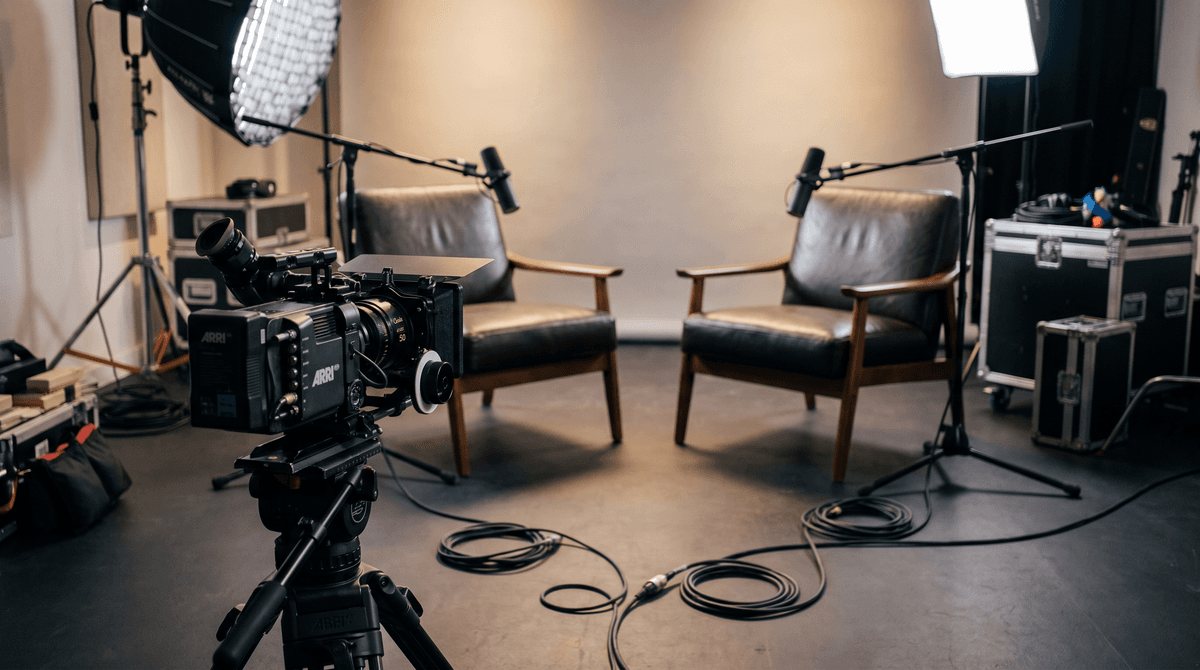
This is not about expensive gear. It is about intentional production. Recording in a properly treated space with directional microphones, clean lighting and stable framing. Editing out the false starts, the long pauses, the technical digressions that add nothing. Structuring an episode so the listener knows in the first two minutes whether this is for them. These are table stakes now, not aspirational polish.
If you are producing a business podcast in London and you want to compete for the attention this data shows is shifting away from radio, you need to make sure every episode you publish is at least as good as the last one your listener heard. That means recording in an environment built for it, working with a team that understands both the content and the distribution, and treating each episode as a permanent asset, not a disposable broadcast.
THE LODGE Studios handles that full process, from concept to final edit to distribution strategy, for clients who need their podcast to work as a business tool. If you are ready to record a show that captures the professional audience radio is losing, book a session at https://book.thelodgestudios.co.uk and we will make sure it is built properly from the first episode.