Why Podcast Credibility Converts Better Than Advertising Ever Will
New voter data proves podcast appearances influence decisions. Here's what that means for business podcast strategy and why long-form audio builds trust…
One in four voters say a podcast appearance could change how they vote. That figure, revealed in new research reported by Podnews, should make every business owner running a podcast sit up. Because if long-form audio can shift someone's political stance, something far more entrenched and identity-driven than a product preference, it can certainly influence whether they hire you, buy from you or recommend you.
The interesting part is not that podcasts have influence. We have known that for years. The interesting part is the mechanism. Political strategists are not booking candidates onto shows because of reach metrics. They are doing it because an hour of unscripted conversation builds credibility in a way a thirty-second ad cannot. The voter hears tone, hesitation, laughter and spontaneity. They form a judgement about character, not just policy. That same process applies when a potential client listens to your podcast. They are deciding whether they trust you long before they ever visit your website.
This is the lesson most business podcasts miss. They approach the medium as if it were a press release with a play button. They script tightly, stay on message and optimise for brevity. Then they wonder why the show does not convert. The answer is simple: you have stripped out the very thing that makes podcasting work. You have removed the credibility-building conversational depth that turns a passive listener into someone who believes you understand their problem and can solve it.
The political data is just the most recent proof of something we see every week at THE LODGE Studios. Clients come in wanting to launch a show. Some understand the strategic value of long-form audio. Others think podcasting is a channel to broadcast at people. The former group builds loyal audiences. The latter struggles with retention after three episodes. The difference is not production quality or topic selection. It is whether the host grasps that credibility is built in the pauses, the tangents and the moments when the guest says something unexpected.
Consider what happens when a politician sits down for an unedited conversation. They cannot rely on a script or a spokesperson. They have to think aloud, defend positions and respond in real time. The audience watches that process and forms an opinion about competence, authenticity and whether this person can handle complexity. Now consider what happens when a consultant or coach does the same. A prospective client hears how you break down a problem, handle objections and guide someone through a decision. They are not evaluating your credentials. They are evaluating whether working with you would feel like this conversation, clear and collaborative. That is a far more powerful signal than any case study.
The mistake is treating podcasting as content marketing when it functions more like a extended sales conversation. Content marketing pushes information outward. A podcast invites someone in. It creates the illusion of proximity. The listener feels they know you because they have spent hours hearing your voice, your thought process and your personality. That familiarity does not guarantee a sale, but it eliminates the friction that usually exists at the top of a funnel. When they finally book a call, they are not starting from zero. They have already decided you are credible. The call is just logistics.
This is why the voter statistic matters beyond politics. It confirms what conversion data has been showing for years. Long-form audio influences decision-making because it mimics the experience of sitting across a table from someone and having a real conversation. It gives the listener time to assess judgment, not just expertise. Expertise is table stakes. Every consultant can claim it. Judgment is what separates someone you hire from someone you keep scrolling past. Judgment is revealed in how you respond to a question you were not expecting, how you weigh trade-offs and whether you admit when something is outside your area. A podcast captures all of that. A LinkedIn post does not.
The format also strips away the polish that makes traditional marketing feel performative. When a guest tells a story about a project that went wrong, or a host admits they changed their mind on something, the audience registers that as honesty. Not because it is confessional, but because it is specific. Specificity is the marker of truth. Generic claims about results or methodology sound like every other pitch. A detailed account of how you solved one particular problem for one particular client sounds like something that actually happened. That distinction is what builds trust, and trust is what converts.
Here is the practical reality for anyone running a business podcast or considering one. You need a structured approach that prioritises credibility over polish. That means longer episodes, not shorter. It means letting conversations develop naturally rather than cutting them into tight segments. It means asking guests questions that require them to think, not recite a prepared answer. And it means being willing to publish episodes where the conversation goes somewhere you did not plan, because those are often the episodes that resonate most.
The process looks like this:
- Choose guests based on the questions they can answer, not their follower count. A guest with deep experience in one narrow area will produce a more credible conversation than someone with a broad platform and surface-level insights.
- Prepare fewer questions and let each answer run longer. Credibility builds in the follow-up, not the prompt. When a guest gives a one-sentence answer, ask them to walk through an example. The detail is where trust forms.
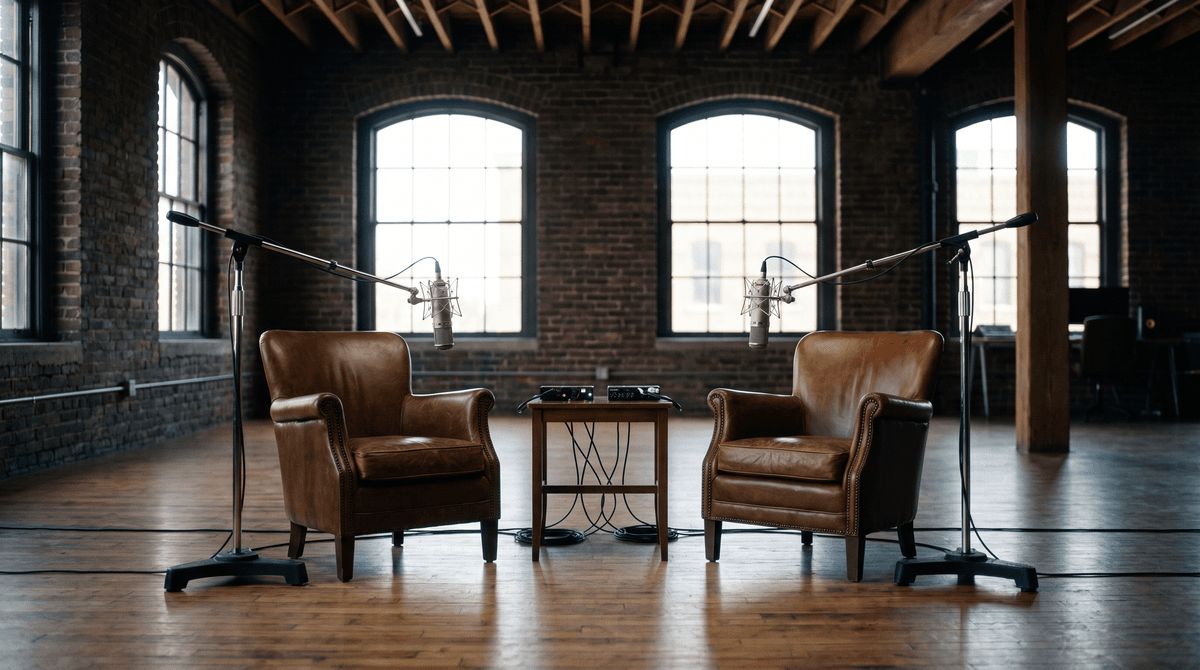
- Record in an environment where the conversation feels natural. A stiff, overly formal setup produces stiff, overly formal answers. A relaxed recording space produces the kind of candid exchange that makes a listener feel they are overhearing something real.
- Edit lightly. Remove the technical errors and the false starts, but leave the pauses and the tangents. Those are not mistakes. They are proof the conversation was not scripted.
- Publish consistently and let the archive build. One episode does not establish credibility. Twenty episodes do. A potential client who listens to three or four before reaching out has already made the decision to work with you. The call is just confirmation.
The voter research also highlights something else: the influence works even when the listener does not agree with everything they hear. One in four saying a podcast could change their vote does not mean one in four changed their vote. It means the format created enough credibility to make them reconsider. That is the realistic goal for a business podcast. You are not trying to convert every listener in one episode. You are trying to move them from skeptical to curious, or from curious to convinced. That shift happens gradually, across multiple episodes and multiple touchpoints. The podcast is the engine. Everything else, the newsletter, the website, the intake call, benefits from the credibility the show has already built.
There is also a competitive advantage here that most businesses are not exploiting. Video podcasting is now the expected format, but most companies either skip video entirely or produce it in a way that undermines credibility. They film in a cluttered office with bad lighting, or they use a virtual background that makes the whole thing look like a webinar. Neither approach works. If the goal is to build trust through long-form conversation, the visual component needs to support that. A clean, well-lit studio setup signals professionalism without feeling corporate. It tells the viewer this was worth doing properly, which implies the content inside is worth their time.
That is where recording environment becomes strategic. You can produce a podcast from anywhere, but the visual and audio quality shape how the audience perceives you before you say a word. A grainy webcam recording says you are figuring this out as you go. A properly lit, properly framed studio recording says you take the work seriously. Both might contain the same conversation, but the second version will hold attention longer and convert at a higher rate. The credibility you are building through the content gets amplified or undermined by the production quality. They are not separate considerations.
The other factor the political research points to is consistency. Candidates do not appear on one podcast and call it done. They do circuits. They go on five, ten, twenty shows because repetition builds familiarity and familiarity builds trust. The same logic applies to a business podcast. One viral episode does not create the credibility that converts. A catalogue of forty episodes does. Because a potential client who finds you through search or referral will often go back and listen to several episodes before deciding to reach out. They are not evaluating one piece of content. They are evaluating whether your point of view holds up across different topics and different guests. That requires volume.
This is also why buying ads or guesting on other shows only gets you so far. Those tactics build awareness, but they do not build the depth of credibility that makes someone choose you over a competitor. Hosting your own show does. Because hosting forces you to demonstrate expertise in real time, week after week. A guest spot lets you deliver your best fifteen minutes. Hosting requires you to stay interesting for an hour, across dozens of episodes, with different guests and different angles. That sustained performance is what convinces a listener you are the real thing.
Looking ahead, the businesses that win with podcasting will be the ones that treat it as a credibility engine, not a content channel. They will invest in proper recording environments, commit to long-form conversations and publish consistently even when download numbers start slow. They will understand that the goal is not virality. The goal is a library of episodes that a prospective client can binge before they ever book a call. That library becomes the most effective sales tool you have, because it does the work of building trust at scale. One conversation, replayed a thousand times, each time moving a listener closer to believing you can solve their problem.
The voter data is just one data point, but it confirms what the best podcast hosts already know. Long-form audio builds influence because it builds credibility, and credibility is what turns attention into action. If you are running a podcast or considering one, the question is not whether the format works. The question is whether you are using it the way it is designed to work, as a space for real conversation that lets an audience decide you are worth trusting. That decision happens gradually, across multiple episodes, but once it happens, the conversion is almost inevitable.
If you are ready to produce a show that builds that kind of credibility, the starting point is recording quality and consistency. THE LODGE Studios in London offers a professional environment designed for long-form conversation, with video and audio setups that make your content look and sound like the serious work it represents. Book a session at https://book.thelodgestudios.co.uk and start building the archive that turns listeners into clients.